
Sports Injuries: When to Ice It and When to See the ER

It happens fast. A kid slides into base and comes up holding a wrist. A weekend basketball game ends with a rolled ankle. A runner finishes a 5K and suddenly feels dizzy and sick.
In the moment, the hardest part is not the injury itself. It is deciding what to do next. Do you ice it and watch it? Head to a walk-in clinic? Or is this an ER situation?
This guide is meant to help you make that call with more confidence, especially during busy sports seasons in and around Rush County.
Why “right level of care” matters
Most sports injuries are not life-threatening, but some need urgent attention to prevent complications. The goal is to match the response to the risk.
- Ice and home care can be great for many mild sprains, strains, and bruises.
- A walk-in clinic can help when symptoms are not improving, you need an evaluation, or you might need imaging or a treatment plan.
- The ER is the right choice for red-flag symptoms like severe bleeding, deformity, concerning head injury symptoms, or signs of heat stroke.
When it is usually OK to ice it at home
Many common sports injuries fall into the “soft tissue” category: strains, mild sprains, and contusions (bruises). The classic approach many clinicians still use is some version of RICE: rest, ice, compression, and elevation.
Signs a home “ice it” plan may be reasonable
- Mild to moderate pain that is improving, not escalating
- Swelling that is mild and stable
- You can move the joint, even if it is sore
- You can bear weight or use the limb with only mild discomfort
- No numbness, no tingling, no color change in fingers or toes
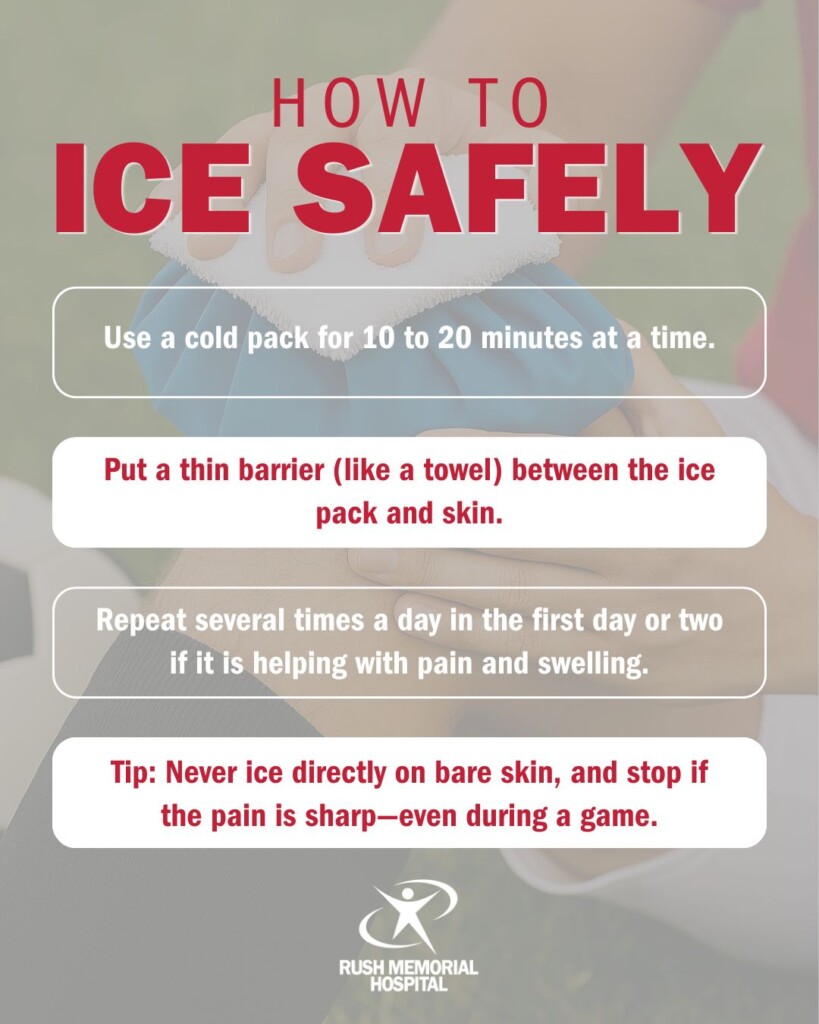
How to ice safely (so it helps, not hurts)
A practical, safe approach:
- Use a cold pack for 10 to 20 minutes at a time.
- Put a thin barrier (like a towel) between the ice pack and skin.
- Repeat several times a day in the first day or two if it is helping with pain and swelling.
Tip: Do not ice directly on skin, and do not push through sharp pain just because you “do not want to miss the game.”
Add compression and elevation if swelling is an issue
Elastic compression and elevating the injured area above the level of the heart can help reduce swelling for many soft tissue injuries.
When to use a walk-in clinic instead of waiting it out
If the injury is not an emergency, but you are not comfortable guessing, that is where a walk-in clinic can help. This is especially true if symptoms are lingering or your athlete needs guidance for a safe return to play.
Consider a walk-in clinic if any of these apply
- Pain is not improving after 24 to 48 hours of rest and basic care
- Swelling is increasing, not decreasing
- The joint feels unstable, locks, or gives out
- You cannot return to normal walking or normal use after a couple days
- You suspect a minor fracture or you want to know if an X-ray is needed
- You need help with bracing, wound care, or a return-to-sport plan
RMH Walk-In Care provides same-day care for minor illnesses and injuries that are not life-threatening and does not require an appointment.
Location and hours (Rushville): 323 Conrad Harcourt Way, with hours listed Monday through Sunday on the RMH Walk-In Care location page.
When to go to the ER for a sports injury
Here are the big red flags. If any of these are happening, it is safer to choose emergency care.
1) Possible broken bone with high-risk signs
Seek emergency help if:
- The limb or joint looks deformed
- The pain is severe with even gentle movement
- There is heavy bleeding
- Bone is visible or has broken through the skin
- Fingers or toes are numb or discolored
- You suspect a neck, head, or back fracture
2) Suspected dislocation
Dislocations can affect blood flow, nerves, and joint stability. They need prompt medical attention, and you should not attempt to “pop it back in” yourself.
Some dislocations, such as an elbow dislocation, are considered emergency injuries.
3) Head injury with concussion danger signs
If there is any concern for concussion, stop play and monitor closely. Go to the ER or call 911 for danger signs after a bump, blow, or jolt to the head or body, such as:
- Worsening headache
- Repeated vomiting
- Unusual behavior, confusion, or increasing agitation
- Drowsiness or inability to wake up
- Seizures
- One pupil larger than the other
If you are making the decision for a child or teen, lean cautious. Kids can have symptoms that evolve over hours.
4) Uncontrolled bleeding or deep wounds
If bleeding is heavy, spurting, or not stopping with firm direct pressure, treat it as an emergency. Apply steady direct pressure and get emergency help.
5) Signs of heat stroke during sports or practice
Heat illness can happen even outside the peak of summer, especially during early warm spells when athletes are not acclimated. Heat stroke is a medical emergency. Warning signs include:
- Confusion or altered mental status
- Loss of consciousness
- Seizures
- Very high body temperature
- Hot, dry skin or heavy sweating
If you suspect heat stroke, call 911.
What to expect if you come to the ER
In the ER, teams focus on stabilizing the injury and ruling out emergencies. That may include:
- Checking circulation, nerve function, and range of motion
- Imaging such as X-ray or CT when needed
- Pain control, splinting, or reduction of a dislocation when appropriate
- Monitoring head injury symptoms or treating heat illness
Local note for Rush County families
Rush Memorial Hospital’s Emergency Department is open 24 hours a day, 365 days a year.
Rush Memorial Hospital is located at 1300 N. Main St., Rushville, IN 46173, and the main phone number is (765) 932-4111.
For non-life-threatening issues, RMH Walk-In Care is located at 323 Conrad Harcourt Way, Rushville, IN 46173, with listed hours and phone information on the RMH site.
Key takeaway
If the injury looks minor and is improving, icing and basic home care may be enough. If it is not improving, a walk-in clinic can help you get clarity and a plan. If there are red flags like deformity, uncontrolled bleeding, concussion danger signs, or heat stroke symptoms, do not wait, choose emergency care.
FAQ: Sports injuries, icing, walk-in clinic, and ER decisions
A common recommendation is 10 to 20 minutes at a time with a cloth barrier, repeating as needed in the first day or two for pain and swelling.
In general, ice is used early when swelling and acute pain are the main issues. Heat is more commonly used later for stiffness. If swelling is increasing or the injury feels unstable, get evaluated.
No. Many sprains and strains do not require imaging. But if pain is significant, function is limited, or symptoms are not improving, a walk-in clinic can help determine whether imaging is appropriate.
Severe bleeding, a deformed limb, bone through skin, numb or discolored fingers or toes, suspected neck or back injury, concussion danger signs, and signs of heat stroke are all reasons to choose the ER.
It is safest to remove them from play and monitor symptoms. Concussion symptoms can show up later, and CDC guidance highlights specific danger signs that require emergency care.
If you are seeing red-flag symptoms, or the person is getting worse quickly, call 911 or go to the ER. When symptoms are not life-threatening but you need same-day evaluation, a walk-in clinic is often a good next step.
Medical disclaimer
This blog is for general informational purposes only and is not a substitute for medical advice, diagnosis, or treatment. Always follow guidance from your healthcare provider. If you think you are experiencing a medical emergency, call 911 or go to the nearest emergency room immediately.